

The underestimated performance killer
A creeping process
Sleep disturbances are among the most stable companions of menopause. Many women report not that they are sleeping too little, but that they are not sleeping restfully. Falling asleep is possible, but the sleep remains shallow, fragmented, or ends too soon. This is often long classified as a temporary burden or stress reaction.
It is well established scientifically that sleep problems during the menopausal transition are not a marginal phenomenon. They are closely associated with hormonal changes and have measurable effects on emotional stability, cognitive performance, and resilience in daily life and work.
The menopause is a natural phase of life. At the same time, it is associated with various physical and mental changes that can affect daily life, performance, and well-being. Studies show that a large number of women experience at least temporary symptoms during this phase that require explanation and are often underestimated.
Why sleep becomes disrupted during menopause
During menopause, the levels of estrogen and progesterone decline. Both hormones influence sleep architecture. Progesterone normally has a sleep-promoting effect and dampens night-time activation. When this effect decreases, many women find it more difficult to achieve stable sleep.
Estrogen influences, among other things, temperature regulation and deep sleep phases. Decreasing estrogen levels are associated with a reduction in those sleep portions that are particularly relevant for physical and mental regeneration.

Sleep disorders are not a random effect of age.
This clearly distinguishes menopausal sleep disturbances from short-term, stress-related sleep problems.
Sleep deprivation as an amplifier of other symptoms
Disturbed sleep acts in the body like an amplifier. Studies show that even moderate, repeated sleep deprivation is associated with increased emotional reactivity, reduced impulse control, and decreased cognitive flexibility.

In experimental studies, women with unstable sleep showed stronger stress reactions to identical stressors than well-sleeping comparison groups.
Sleep problems thus amplify many other symptoms that can occur during menopause.
Night sweats and sleep architecture
Nighttime hot flashes not only act as a short-term awakening stimulus but also alter the entire sleep structure. Polysomnographic studies show shortened deep sleep phases, frequent micro-awakening reactions, and reduced sleep continuity.
The decisive factor is:
Even if affected individuals feel they have slept long enough, the restorative quality of sleep remains limited.

Menopause, sleep, and performance
Sleep deprivation gradually affects performance. Many sufferers continue to function in everyday life, but report faster exhaustion, lower mental resilience, and reduced concentration stability.
Especially in responsible professional roles, this decline in performance remains invisible for a long time, until exhaustion becomes chronic.
When sleep becomes a constant construction site, it affects entire teams.
→ Impulse or Workshop for Teams
Thought loops and nightly activation
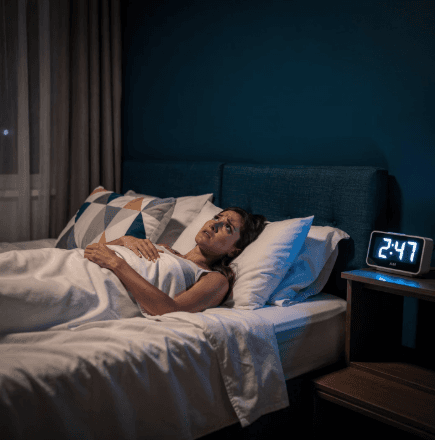
In addition to hormonal effects, psychological processes play a central role. Many women report that waking up at night is accompanied by rumination. Studies show that the threshold for nighttime cognitive activation decreases during perimenopause.
Thoughts that seem controllable during the day gain dominance at night and make it difficult to fall back asleep. This mechanism exacerbates sleep problems regardless of the external stress level.
Sleep disorders in the work context
In the work context, sleep problems often go unaddressed. At the same time, work psychology studies show that lack of sleep is associated with increased susceptibility to errors, reduced decision-making quality, and lower frustration tolerance.
Sleep is not a private matter.
→ Aware & Leadership Module

What helps with sleep disturbances during menopause?
Studies show that effective approaches lie less in individual measures than in the stabilization of biological and psychological rhythms. What matters is regularity, not perfection.
Helpful are among other things:
Consistent sleep and wake times
Reduction of nighttime activation
Conscious stress regulation in the evening
Realistic daily workload